
Key Takeaways
- Congress approved a federal spending bill that will ban most hemp derived cannabinoids by the end of 2026.
- The bill is a direct response to inconsistent lab testing, mislabeled products, and safety concerns.
- The law sets a strict 0.4 mg total THC per container limit. This will eliminate almost all intoxicating hemp products.
- The hemp sector failed to establish unified scientific and regulatory standards.
- Transparent and science focused companies such as CraftCanna show what the industry should have looked like from the beginning.
- The future of hemp now depends on responsible practices and rigorous scientific oversight.
Introduction: A Hemp Industry Outrunning Its Rulebook
The 2018 Farm Bill opened the door for a nationwide hemp market. It also created a regulatory vacuum. The result has been years of unchecked product development, inconsistent testing, and legal loopholes that allowed intoxicating hemp products to reach consumers with little oversight.
In late 2025, Congress responded with the most sweeping change to hemp law since 2018. The new federal spending bill redefines the boundaries of what qualifies as legal hemp. It will ban nearly all intoxicating hemp derived products by the end of 2026. According to national reporting, the law imposes a 0.4 mg total THC per container limit that includes Delta 9 THC, THCa, Delta 8 THC, Delta 10 THC, HHC, THC P, and all similar cannabinoids (ABC News, 2025).
This is not a small adjustment. It is a fundamental shift that reshapes the industry.
While this policy is abrupt, it is also the predictable result of years of weak regulation. Science based standards were never fully implemented. Testing was inconsistent across states. Federal agencies hesitated to provide structure. Now the entire sector is feeling the consequences.
The Spending Bill That Changes Everything
Within the 2025 to 2026 appropriations package, Congress included a clause that places strict limits on total THC. Legal analysts confirm that the law sets a 0.4 mg total THC per container threshold for any hemp product sold in the United States (Clark Hill PLC, 2025).
This limit is not based on dry weight. It is based on the entire finished product.
This instantly disqualifies:
- THCa flower
- Delta 8 and Delta 10 edibles and vapes
- HHC and THC P products
- Most hemp pre rolls
- Most infused beverages
- Most hemp derived gummies
- Almost all current consumer products that produce intoxicating effects
The law becomes mandatory at the end of 2026. Retailers and manufacturers will be forced to discontinue nearly all existing SKUs unless Congress changes course.
Why Congress Acted: A Failure of Scientific Standards
Congress did not impose these limits without reason. The hemp market has been plagued by safety issues, inconsistent quality, and defective oversight for several years.
1. Testing Inaccuracies and Lab Shopping
A 2022 study found that more than half of hemp products sold in the United States were inaccurately labeled for cannabinoid content (Johnson et al., 2022). Another nationwide study conducted in 2023 reported that some products exceeded legal Delta 9 limits by more than one hundred percent (ElSohly et al., 2023).
In some states, companies routinely sent samples to less stringent laboratories to obtain favorable Certificates of Analysis. This practice, often called lab shopping, eroded trust and created significant public health risks.
2. No Mandatory GMP Manufacturing Requirements
Unlike dietary supplements, pharmaceuticals, or food products, most hemp products were not required to be produced in GMP certified facilities. This created problems related to batch consistency, sanitation, and traceability.
3. Hazardous Synthetic and Semi Synthetic Cannabinoids
Investigations in New York, Florida, and California found that some hemp derived vapes contained heavy metals, residual solvents, and synthetic byproducts created during chemical conversion of cannabinoids such as Delta 8 THC (Hernandez et al., 2024).
This was a major driver of federal intervention.
4. A Patchwork of State Laws and Absent Federal Leadership
The USDA regulates hemp cultivation. The FDA has stated that CBD cannot be marketed as a dietary supplement. The DEA has issued unclear guidance about certain cannabinoids. None of the agencies developed a unified framework for consumer products (FDA, 2023).
The hemp market became a national free for all. Congress acted because no agency stepped in to create science based standards.
The New Law Is Overly Restrictive, Yet Predictable
The 0.4 mg total THC limit is not supported by toxicology or pharmacology. It is a policy reaction to a market that lawmakers felt was spinning out of control.
When industries fail to self regulate, government interventions are often blunt. That is exactly what has happened here. The law eliminates almost every intoxicating hemp product rather than establishing balanced safety controls.
Although the policy is extreme, the underlying message from Congress is clear. Public health and consistent science matter more than convenience or loopholes.
Consumer Safety: The Shared Priority Behind the Policy
Despite disagreements about federal overreach, nearly everyone agrees that the hemp marketplace has struggled with product safety.
Independent studies and state investigations have found:
- mislabeled THC potency
- inaccurate CBD levels
- lead and arsenic contamination
- solvent residues
- mislabeled intoxicating derivatives
- products marketed to minors
A 2024 Consumer Reports investigation found that approximately one quarter of hemp edibles contained either contaminants or incorrect cannabinoid quantities.
From Congress’ perspective, this justified drastic regulation.
Where Responsible Brands Stand Now
Despite the problems in the broader marketplace, many companies have always operated with honesty and scientific rigor.
Brands such as CraftCanna have voluntarily implemented:
- ISO accredited third party testing
- precise labeling of cannabinoid and terpene ratios
- consistent balanced dosing
- GMP style workflows
- transparent consumer communication
These practices show what the industry could have been if science had guided it from the beginning.
The new law will challenge every brand. However, companies that prioritize transparency will have a smoother transition and more options for future compliance, including participation in emerging regulated cannabis markets or non intoxicating hemp wellness sectors.
What Real Science Based Regulation Should Look Like
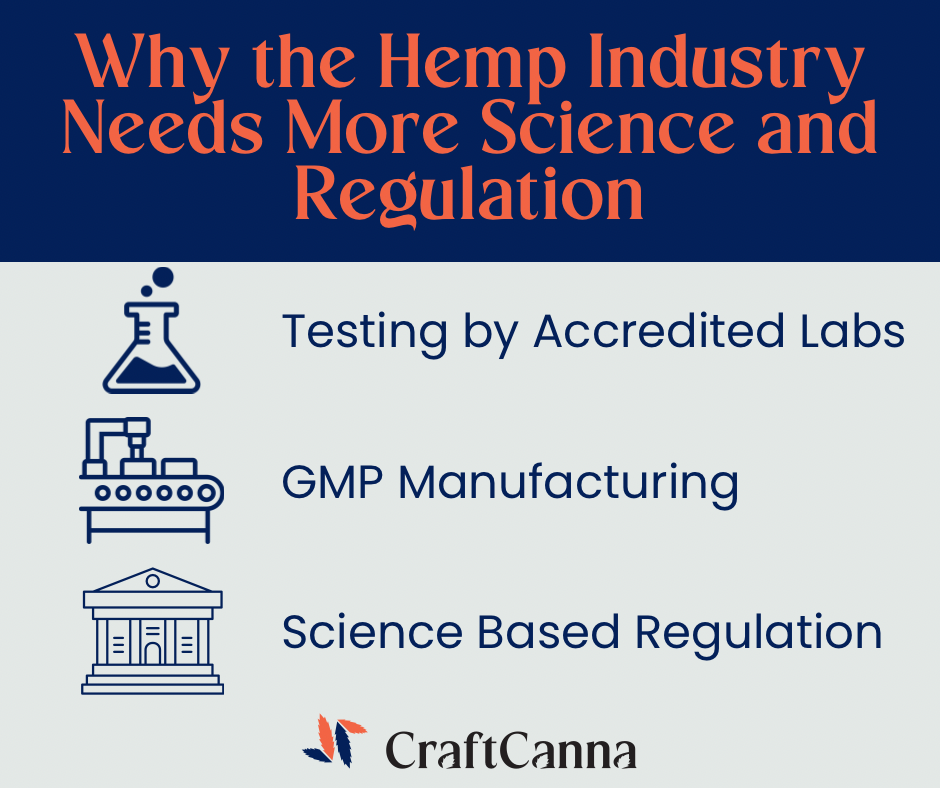
Even though the federal spending bill is highly restrictive, there is still room to advocate for a rational, science focused regulatory system. A comprehensive framework should include:
1. Federal Testing Standards
Labs should follow validated national methods for cannabinoid quantification and contaminant detection.
2. Mandatory ISO 17025 Accreditation
This would remove variability between laboratories and eliminate most incentives for lab shopping.
3. Required GMP Manufacturing
The hemp industry should follow the same safety expectations as supplement and food producers.
4. Label Transparency and QR Code COAs
Product labels should clearly include cannabinoid ratios, terpene profiles, contaminant screenings, and batch information.
5. Increased Federal Research Funding
The NIH and NIDA should expand studies on cannabinoid safety, toxicology, agricultural best practices, and product pharmacology.
6. A Science Based THC Threshold
A reasonable limit would regulate intoxicating cannabinoids without banning hemp products altogether.
The Industry Cannot Survive Without Scientific Integrity
The new federal spending bill represents a turning point. Hemp will not return to the unregulated environment it once enjoyed. The future of the industry will depend on scientific validation, consistent safety standards, and cooperation with federal and state authorities.
Companies that operate with integrity and transparency will adapt and endure. Those that rely on loopholes will struggle to survive.
Conclusion: Science and Safety Must Guide the Future of Hemp
The 2025 spending bill is disruptive and harsh. It is also a clear indication that the federal government lost confidence in the existing hemp marketplace. Years of inconsistent testing, vague state regulations, and unverified cannabinoid conversions created a credibility crisis.
The only path forward is a science focused, transparent, and responsible industry.
Consumers deserve products that match their labels.
Regulators deserve a framework they can enforce.
Trustworthy companies deserve a level playing field.
The future of hemp now depends on science, not loopholes.
For a model of transparent testing and responsible formulation, explore CraftCanna’s lab verified pre rolls and see how safety and quality can guide the next era of hemp.
References
ABC News. (2025). THC gummies and drinks face ban under provision in government spending bill.
Clark Hill PLC. (2025). Federal ban on hemp derived THC products.
Consumer Reports. (2024). CBD and hemp product testing reveals contaminants and labeling issues.
Drug Enforcement Administration. (2023). Hemp and cannabinoid classifications under the Controlled Substances Act.
ElSohly, M. A., et al. (2023). Variability in hemp derived THC concentrations. Journal of Analytical Toxicology, 47(5), 320 to 329.
Food and Drug Administration. (2023). FDA regulation of cannabis and cannabis derived products.
Hernandez, L., Patel, R., and Gordon, S. (2024). Contaminants in unregulated hemp vaping products. Journal of Cannabis Research, 6(2), 112 to 118.
Johnson, M., Smith, D., and Patel, N. (2022). Evaluation of cannabinoid labeling accuracy among retail hemp products. Journal of Cannabis Research, 4(1), 22 to 33.
Williams, B., et al. (2023). Scientific best practices in cannabis product development. Journal of Cannabis Science, 11(3), 145 to 162.

Leave a Reply