
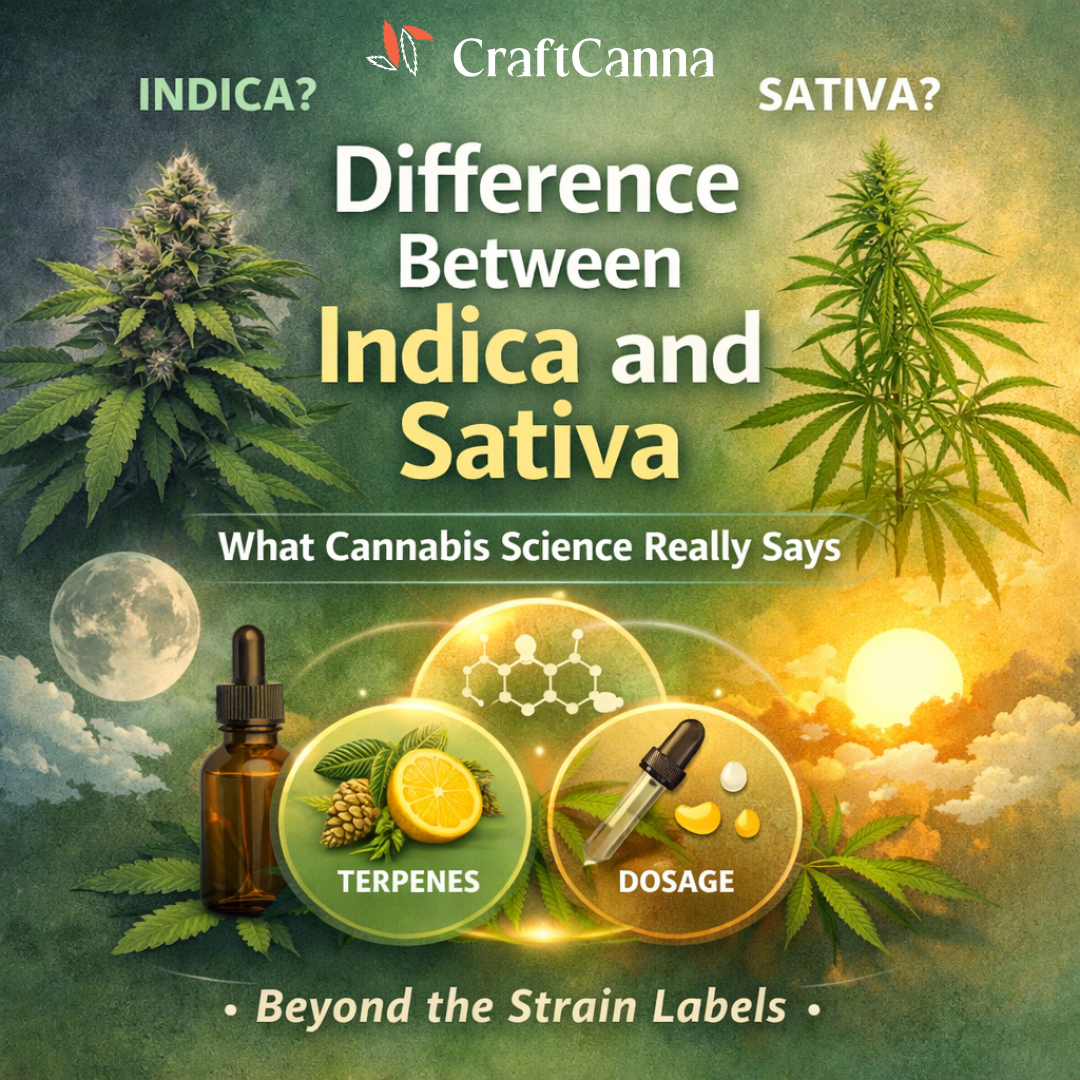
The difference between indica and sativa is one of the most searched questions in cannabis. It is also one of the most misunderstood. For decades, consumers were told that indica strains relax while sativa strains energize. However, modern cannabis research tells a more nuanced story.
Today, scientists, breeders, and medical professionals largely agree that the indica versus sativa distinction does not reliably predict effects. Instead, cannabinoid ratios, terpene profiles, and dosing play a far greater role. This shift matters for consumers who want consistent, functional experiences.
At CraftCanna, we focus on accuracy, balance, and repeatability. That philosophy aligns with the latest cannabis science. Let’s explore where indica and sativa came from, why the labels fall short, and what actually determines how cannabis makes you feel.
Where Did Indica and Sativa Come From?
The terms indica and sativa originated as botanical classifications, not effect categories. Cannabis sativa was first described by Carl Linnaeus in 1753. It referred to tall hemp plants grown in Europe for fiber and seed. Cannabis indica was later described by Jean Baptiste Lamarck in 1785 after observing shorter, broader-leaf plants from India.
Originally, these labels described physical traits. They were not meant to predict psychoactive effects. However, as cannabis prohibition spread, informal classifications replaced scientific nuance. Over time, indica became associated with relaxation while sativa became linked to energy.
Unfortunately, decades of hybridization blurred these distinctions. Most modern cannabis strains contain genetics from multiple lineages. As a result, the original botanical categories lost predictive value.
The Problem With Indica vs Sativa Effects
Many people still report feeling relaxed from indica strains and energized from sativa strains. That experience is real. However, the cause is often misunderstood.
Research shows that the subjective effects of cannabis are driven by chemistry, not plant shape or lineage. Two strains labeled “sativa” can produce entirely different effects. The same is true for indica. This inconsistency creates confusion for consumers.
A 2018 genetic analysis published in Nature Plants found that common strain labels do not reliably match genetic differences (Sawler et al., 2015). Another study showed that terpene profiles vary widely within indica and sativa categories (Hazekamp et al., 2012).
In other words, the difference between indica and sativa is not a dependable guide.
What Actually Determines Cannabis Effects?
Cannabinoid Ratios Matter
THC and CBD are the most well-known cannabinoids. However, their ratio is critical. THC can produce euphoria, altered perception, and stimulation. CBD can moderate THC’s intensity while promoting calm and balance.
Low-dose THC combined with CBD often produces functional effects. This approach reduces anxiety and overstimulation. That is why CraftCanna formulates products with intentional THCa to CBD ratios.
Dose Changes Everything
Dose is one of the most overlooked variables. Even stimulating terpene profiles can feel sedating at higher doses. Conversely, low doses often feel clear and functional.
This is why accurate dosing matters. It is also why CraftCanna emphasizes consistency across every pre-roll.
Terpenes Drive Experience
Terpenes are aromatic compounds found in cannabis and many other plants. They influence flavor, aroma, and effects. More importantly, terpenes interact with cannabinoids through the Ensemble Effect.
Common terpenes include:
- Myrcene, often associated with relaxation
- Limonene, linked to mood elevation
- Pinene, which may support alertness
- β-Caryophyllene, known for stress modulation
Terpenes explain why some products feel uplifting while others feel grounding. They also explain why indica and sativa labels fail.
Terpene Comparison Table: What Really Drives Cannabis Effects
| Terpene | Common Aroma & Flavor | Typical Functional Effects | Often Found In | Indica or Sativa? |
| Myrcene | Earthy, musky, herbal, clove | Reduced mental stimulation, muscle relaxation, enhanced cannabinoid permeability (Russo, 2011) | Mango, hops, thyme | Found in both. Often mislabeled as “indica-leaning.” |
| Limonene | Citrus, lemon peel, bright | Mood elevation, stress relief, mental clarity (Zhang et al., 2019) | Citrus rinds, juniper | Found in both. Commonly associated with “sativa-like” effects. |
| Pinene (α & β) | Pine, fresh forest, rosemary | Increased alertness, memory retention, bronchodilation (Russo, 2011) | Pine needles, basil | Found in both. Can feel stimulating at low doses. |
| β-Caryophyllene | Peppery, spicy, woody | CB2 receptor activation, stress modulation, physical comfort (Gertsch et al., 2008) | Black pepper, cloves | Found in both. Unique for interacting with CB2 receptors. |
| Terpinolene | Floral, herbal, slightly sweet | Uplifted mood, creativity, antioxidant activity (Russo, 2011) | Lilac, nutmeg | Found in both. Often misclassified as “sativa.” |
| Humulene | Woody, hops, earthy | Appetite suppression, grounding effects (Guimarães et al., 2012) | Hops, coriander | Found in both. Frequently paired with myrcene. |
| Ocimene | Sweet, herbal, fresh | Energetic, social stimulation, (Başer & Buchbauer, 2010) | Mint, parsley | Found in both. Perceived as “sativa-like” due to aroma. |
| Linalool | Floral, lavender | Calm, anxiolytic effects, stress reduction (Linck et al., 2010) | Lavender, coriander | Found in both. Commonly labeled “indica.” |
How CraftCanna Uses Terpene Profiles
CraftCanna products are formulated around terpene-forward experiences instead of outdated strain labels.
- Stimulate emphasizes limonene, pinene, and β-caryophyllene for an energetic, social experience.
- Innovate leans into terpinolene and ocimene to support creativity and focus.
- Chill highlights myrcene, humulene, and β-caryophyllene for relaxation and calm.
Each product uses consistent THCa and CBD dosing to ensure predictable results.
Indica vs Sativa Through a Scientific Lens
Modern cannabis science favors the term chemovar. Chemovars classify cannabis by chemical composition rather than ancestry. This model is more precise. It also aligns with how the body actually responds.
A chemovar approach considers:
- THC and CBD content
- Minor cannabinoids
- Terpene profile
- Delivery method
- Individual tolerance
From this perspective, the difference between indica and sativa becomes secondary. Chemistry becomes primary.
Why the Labels Still Exist
Despite their flaws, indica and sativa labels persist for marketing reasons. They provide simple shorthand. They also match consumer expectations.
However, simplicity comes at a cost. Consumers may choose products that do not meet their needs. This is especially true for people seeking functional or low-dose experiences.
Education is slowly changing this landscape. Brands that prioritize transparency are leading the shift.
Terpenes and the Ensemble Effect
The Ensemble Effect describes how cannabinoids and terpenes work together to shape experience. This concept is supported by preclinical and observational research (Russo, 2011).
For example, THC combined with myrcene may feel more relaxing. THC paired with limonene and pinene may feel brighter and more social. CBD further modulates these effects.
CraftCanna products are formulated with this interaction in mind. Each product is designed around a specific functional goal rather than a strain label.
How CraftCanna Applies Modern Cannabis Science
CraftCanna does not rely on indica or sativa labels. Instead, we focus on terpene-driven experiences with consistent dosing.
CraftCanna Stimulate
Stimulate features a terpene blend rich in limonene, pinene, and β-caryophyllene. The flavor profile includes sweet pineapple, fresh citrus, and tropical haze. The experience is energetic, social, and uplifting. Many consumers would traditionally call this a “sativa” effect.
However, the experience comes from chemistry, not lineage.
CraftCanna Innovate
Innovate emphasizes terpinolene, myrcene, and ocimene. The flavor profile includes sour lemon, fresh pine, and sweet gasoline. The effect supports creativity and focus. This profile defies simple indica or sativa categorization.
CraftCanna Chill
Chill features myrcene, pinene, β-caryophyllene, and humulene. The flavor profile includes ripe blueberry, soft cookie, and sweet pine. The experience is relaxed and calming. This is often associated with indica. Again, terpenes and dose drive the effect.
Across all products, consistent THCa and CBD dosing supports balance and predictability.
Indica vs Sativa for Medical and Wellness Use
Medical cannabis patients often rely on predictable outcomes. Indica and sativa labels can create false expectations.
Studies suggest that terpene profiles may influence anxiety, pain perception, and sleep quality (Baron, 2018). CBD content also plays a major role in tolerability.
For wellness-focused consumers, low-dose products with clear labeling offer better control. This approach reduces trial and error.
How Consumers Should Choose Cannabis Today
Instead of asking whether a product is indica or sativa, consider asking:
- What are the dominant terpenes?
- What is the THC to CBD ratio?
- What dose fits my tolerance?
- What functional outcome am I seeking?
These questions lead to better experiences. They also align with how cannabis actually works in the body.
The Future of Cannabis Classification
The industry is slowly moving toward chemistry-based labeling. Some markets already require terpene disclosure. Others are exploring standardized effect categories.
As research expands, consumers will gain better tools. Brands that invest in transparency will earn trust.
CraftCanna was built with this future in mind.
Final Thoughts on the Difference Between Indica and Sativa
The difference between indica and sativa is more historical than scientific. While the terms remain popular, they do not reliably predict effects. Terpenes, cannabinoids, and dose matter far more.
Understanding this shift empowers consumers. It also supports safer, more enjoyable cannabis use.
If you are looking for consistent, functional experiences grounded in real science, explore terpene-driven products designed with intention.
Ready to experience cannabis beyond outdated strain labels? Explore the CraftCanna Collection and discover terpene-balanced, low-dose pre-rolls designed for clarity, creativity, and calm.
References
Baron, E. P. (2018). Medicinal Properties of Cannabinoids, Terpenes, and Flavonoids in Cannabis, and Benefits in Migraine, Headache, and Pain: An Update on Current Evidence and Cannabis Science. Headache: The Journal of Head and Face Pain, 58(7), 1139–1186. https://doi.org/10.1111/head.13345
Başer, K. H. C., & Buchbauer, G. (2010). Handbook of essential oils: Science, technology, and applications. CRC Press. https://doi.org/10.1201/9781420063165
Gertsch, J., Leonti, M., Raduner, S., Racz, I., Chen, J. Z., Xie, X. Q., Altmann, K. H., Karsak, M., & Zimmer, A. (2008). Beta-caryophyllene is a dietary cannabinoid. Proceedings of the National Academy of Sciences, 105(26), 9099–9104. https://doi.org/10.1073/pnas.0803601105
Guimarães, A. G., Quintans, J. S., & Quintans-Júnior, L. J. (2012). Monoterpenes with analgesic activity – A systematic Review. Phytotherapy Research, 27(1), 1–15. https://doi.org/10.1002/ptr.4686
Hazekamp, A., Fischedick, J. T., & Verpoorte, R. (2012). Cannabis – from cultivar to chemovar. Drug Testing and Analysis, 8(7), 660–667. https://doi.org/10.1002/dta.407
Linck, V. M., da Silva, A. L., Figueiró, M., Piato, A. L., Herrmann, A. P., Dupont Birck, F., Caramão, E. B., Nunes, D. S., Moreno, P. R. H., Eisabetsky, E. (2010). Inhaled linalool-induced sedation in mice. Phytomedicine, 17(8–9), 679–683. https://doi.org/10.1016/j.phymed.2008.08.001
Russo, E. B. (2011). Taming THC: Potential cannabis synergy and phytocannabinoid-terpenoid entourage effects. (7), 1344–1364. https://doi.org/10.1111/j.1476-5381.2011.01238.x
Sawler, J., Stout, J. M., Gardner, K. M., Hudson, D., Vidmar, J., Butler, L., & Page, J. E. (2015). https://doi.org/10.1016/j.phymed.2009.10.001The genetic structure of marijuana and hemp. PLoS ONE, 10(8), e0133292. https://doi.org/10.1371/journal.pone.0133292
Zhang, L. L., Yang, Z. Y., Fan, G., Ren, J. N., Yin, K. J., & Pan, S. Y. (2019). Antidepressant-like effect of Citrus sinensis (L.) Osbeck essential oil and its main component limonene on mice. Journal of agricultural and food chemistry, 67(50), 13817-13828. https://pubs.acs.org/doi/abs/10.1021/acs.jafc.9b00650

Leave a Reply